

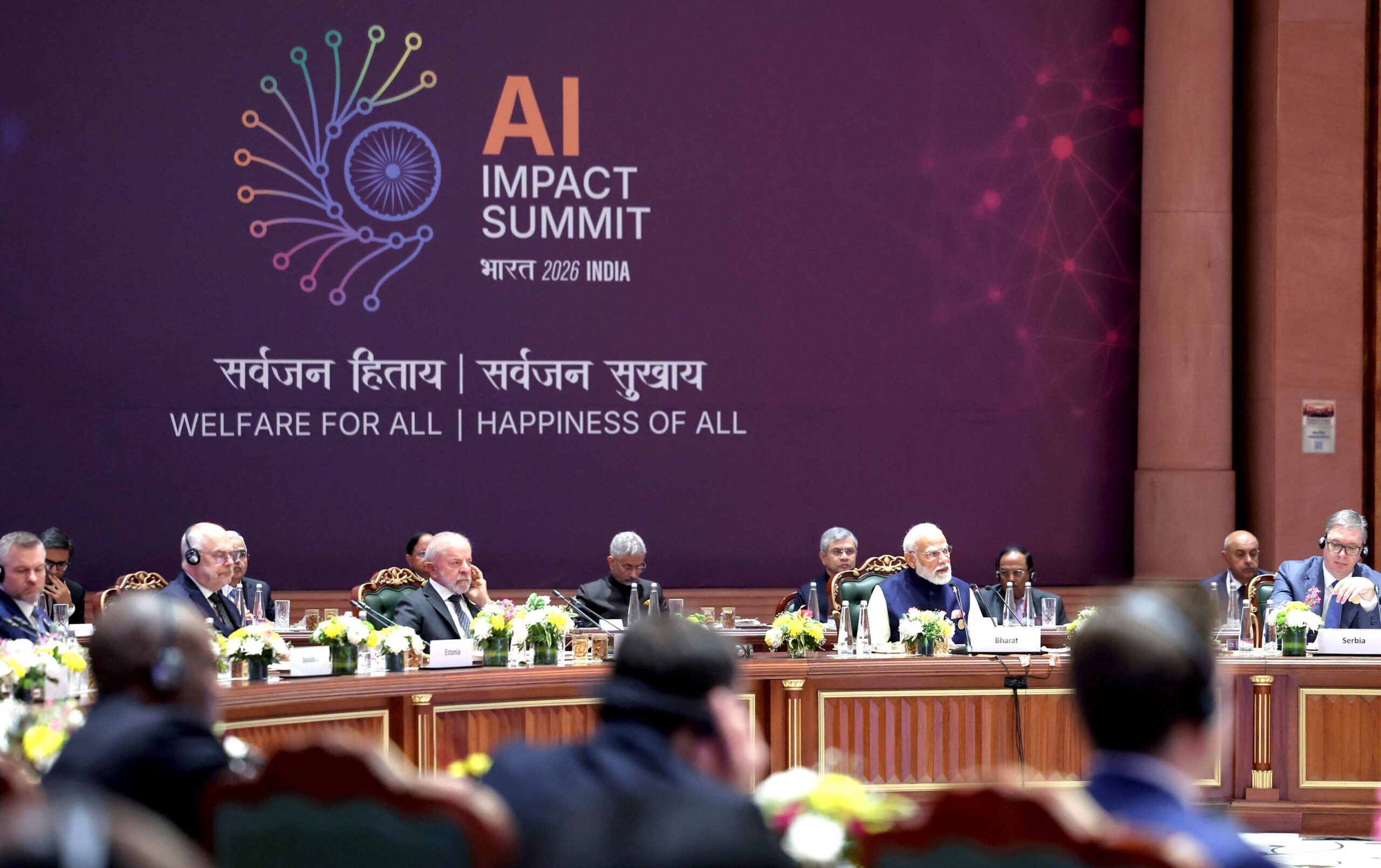
The biggest question today is not if artificial intelligence will change the world—it certainly will. The real issue is whether people will guide that change, or if it will simply follow market trends and global competition. India has decided to face this challenge directly. Led by Prime Minister Narendra Modi, the country has set out a clear vision: technology should help everyone, not just those who already have advantages because of where they live, the language they speak, or their wealth.
Democratising AI for the Common Good
“India’s perspective on AI is reflected in the theme of this summit, Sarvajan Hitay, Sarvajan Sukhaye or ‘welfare for all, happiness for all.’ This is our benchmark.” – PM Narendra Modi at the AI Impact Summit 2026, Delhi.
PM Modi at the AI Impact Summit in Delhi noted that India, with its large youth population and tech talent pool, represents one-sixth of humanity and is positioned to lead the AI revolution. Modi introduced his M.A.N.A.V. vision, which advocates for Moral and Ethical Systems, Accountable Governance, National Sovereignty, Accessibility, and Legitimacy in AI. He emphasised that AI should be democratised to ensure it serves the global common good and meets local needs, from supporting farmers in rain-dependent areas to aiding urban planning in growing cities. Modi also celebrated the launch of three Indian AI models at the summit, reflecting India’s innovative solutions. His address reinforced that AI’s true potential lies in its ability to uplift all, ensuring that technology serves humanity’s collective progress.
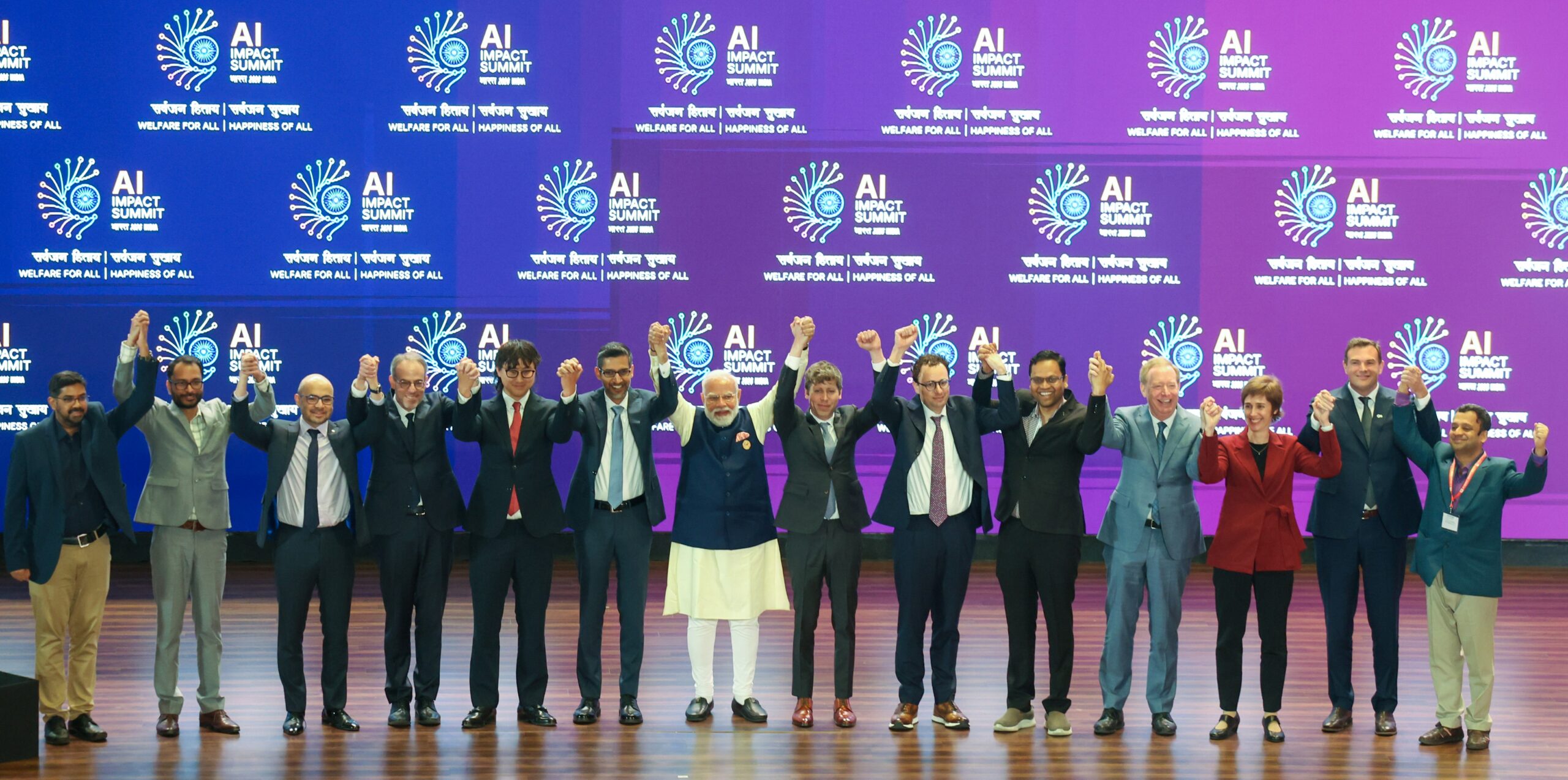
PM Modi’s M.A.N.A.V. vision for AI emphasises:
- Moral and Ethical Systems
- Accountable Governance
- National Sovereignty
- Accessible and Inclusive
- Valid and Legitimate
This vision aims to ensure AI is ethical, accountable, inclusive, and aligned with national interests, creating technology that benefits all.
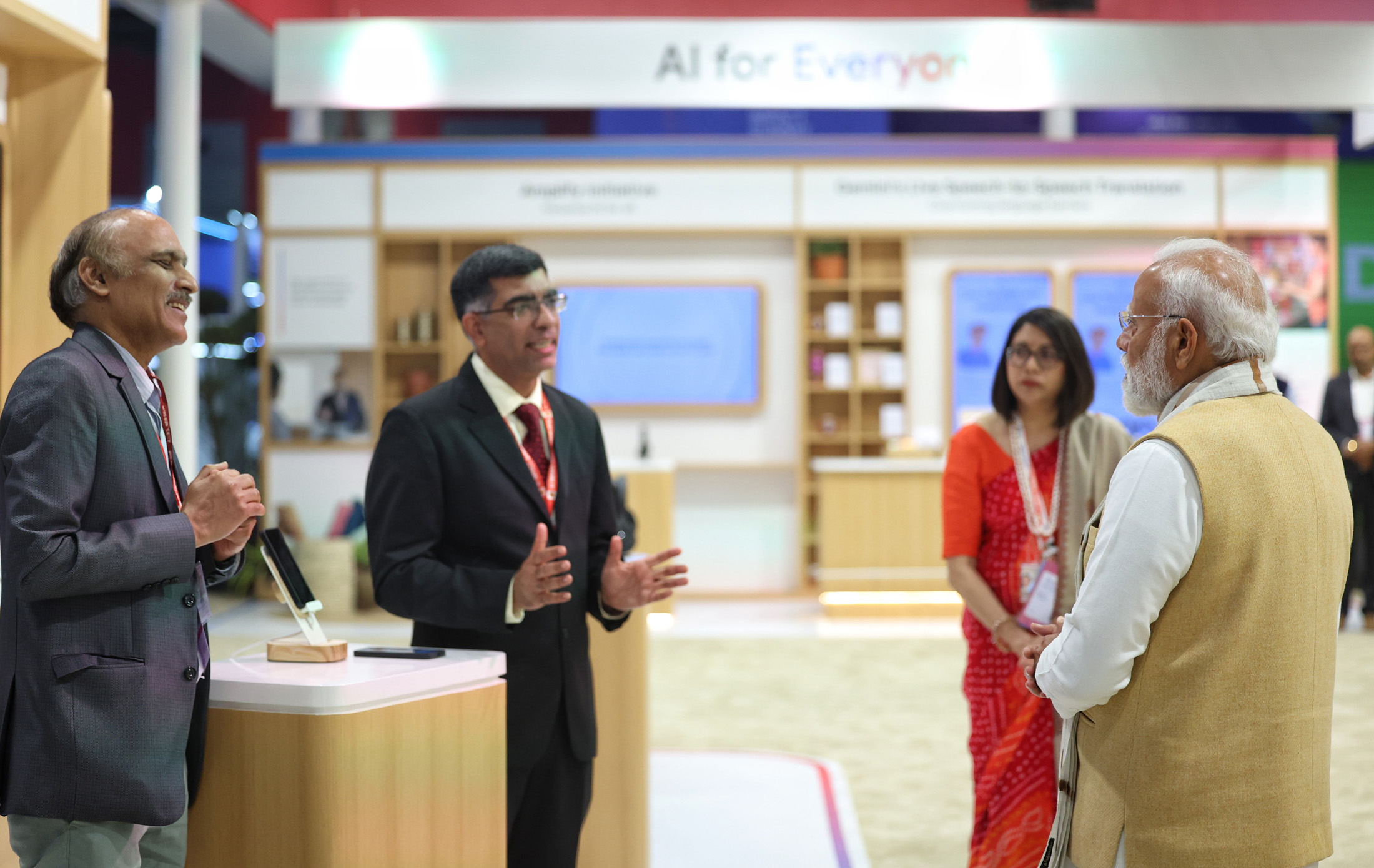
Additionally, PM Modi highlighted India’s unique ability to leverage AI to solve real-world challenges, stressing that the nation’s approach is rooted in ensuring AI is not just a tool of the privileged but a means of empowerment for the masses. He noted that India’s youth is embracing AI like never before, signalling a promising future for innovation that reaches every part of the country. The Prime Minister urged global collaboration on AI development, aligning with India’s philosophy of open, accessible technology that promotes inclusion and shared prosperity.
Tech Must Serve Local Needs
“Science is universal, but technology must be local.”
Prime Minister Modi’s words are not just slogans; they have been grounded in local contexts and have guided India’s digital strategy.[1] PM Modi has long believed that technology should be deeply rooted in local values and needs to solve real-life problems. A handwritten excerpt from his personal diary reinforces this view: “Science is universal, but technology must be local.” This reflects his belief that while scientific advancements are shared globally, technology becomes truly valuable only when tailored to specific local challenges.

In India, this principle is evident in several initiatives, including the IndiaAI Safety Institute, which aims not only to regulate AI but also to ensure it meets the nation’s unique demands. By addressing local issues, such as supporting farmers in rain-dependent regions or aiding urban planning in rapidly growing cities, India’s approach to technology goes beyond just offering solutions; it ensures inclusivity and equal access for all, particularly those at the margins. The focus is on technology that serves the people, grounded in India’s diverse realities.
AI Should Amplify Human Potential
Many people today worry that artificial intelligence will take away jobs. Prime Minister Modi has often challenged this idea. In an interview with ANI, he said, “Technology exists to serve humanity, not replace it.” This is more than just comforting words—it demonstrates a genuine focus on people in how India is using AI across different fields.
PM Modi acknowledged the concerns many young Indians have about AI-driven changes, but he rejected the notion that nothing can be done. He says disruption will happen—it always has—but every past wave of new technology has created more jobs than it replaced. What changes is the type of work, not whether work exists. The urgent task, he believes, is to prepare: invest in skills, retraining, and strong institutions to manage change rather than be overwhelmed by it. He is also very aware of the ethical issues. Technology, he says, is only as good as the intent behind it. While AI can greatly increase human abilities, people must always be responsible for their decisions. This is why India’s approach to AI governance is based not just on restrictions, but on accountability—requiring transparency, human oversight, and strict rules against harmful uses. The IndiaAI Safety Institute’s rules on watermarking AI-generated content and the Digital Personal Data Protection Act both reflect India’s efforts to ensure its AI growth does not outpace its safeguards.
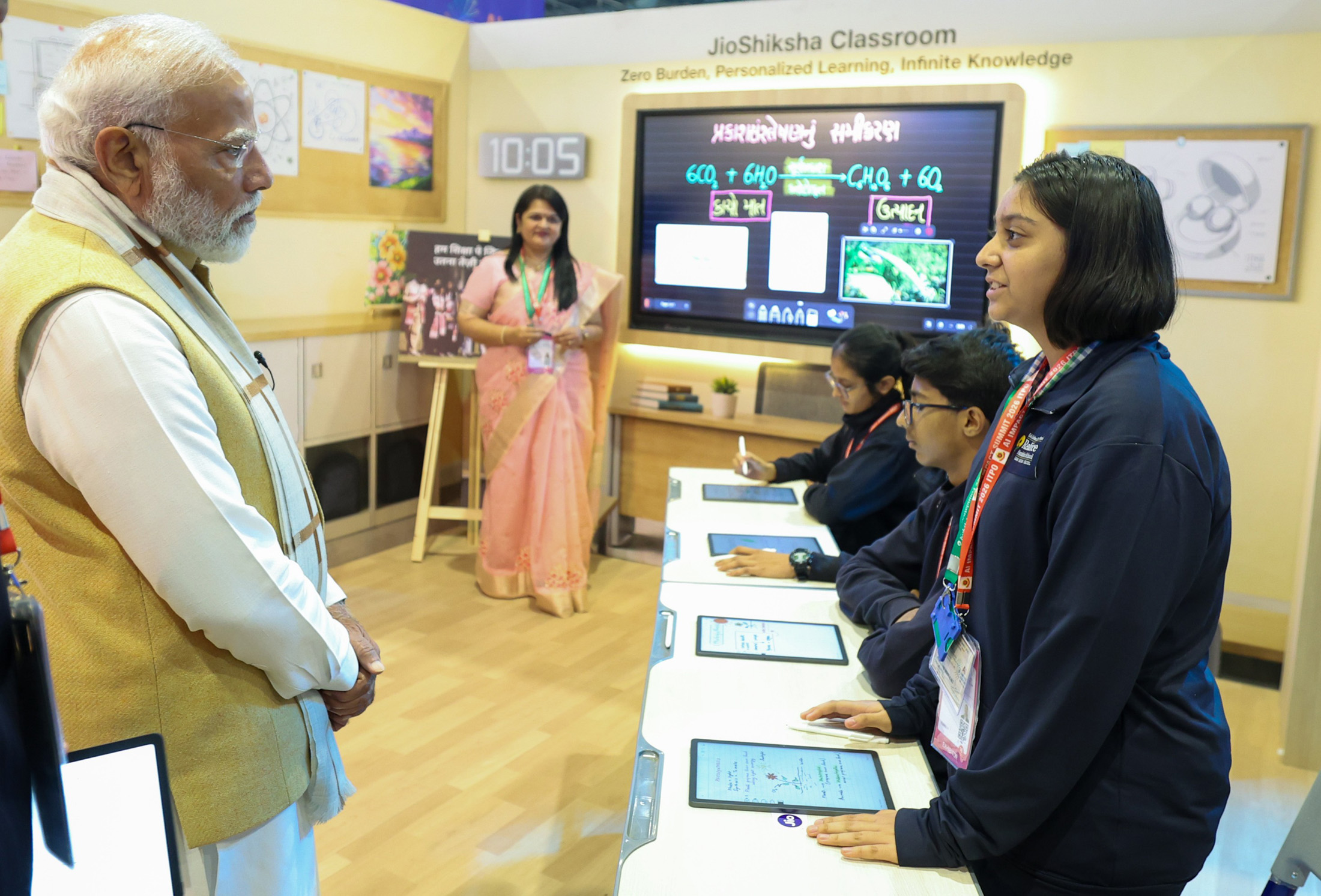
In healthcare, AI-driven diagnostic platforms are already identifying tuberculosis and diabetic retinopathy at primary health centres in rural India, enabling early detection for populations with limited access to specialist care. In education, AI-powered personalised learning is reaching students in their native languages, narrowing a gap that conventional schooling had long struggled to close.
The infrastructure enabling all of this, Aadhaar, UPI, and a growing network of digital public services, shows that India can use AI while still promoting fairness in society. Other countries are beginning to notice and study how India balances these goals.
“We are not only sharing technology with other nations but also helping them develop it. This is not Digital Aid, it is Digital Empowerment.”- PM Narendra Modi, Global Fintech Fest, 2025[2]
In his book Exam Warriors, Prime Minister Modi advises students and parents that while technology accelerates and democratises learning, it should never crowd out lived experience, human connection, or physical engagement. The risk is real: screen-mediated lives can produce disconnection as readily as empowerment. Therefore, it is imperative to gather from PM Modi’s words from Pariksha Pe Charcha (also highlighted in https://www.narendramodi.in/modimasterclass) that online is for gaining, offline is for applying. The standard for evaluating technology is not whether it is advanced, but whether it makes lives more whole, more capable, more connected, and more free; rather than merely more convenient.
India and France: A Partnership for Global Transformation
India’s ambition is not confined to its own borders. At a recent CEO Forum, Prime Minister Modi captured the logic of global collaboration with striking clarity: “When France’s finesse and India’s scale meet, when India’s pace and France’s precision join, when France’s technology and India’s talent unite, then, not just business landscape, but global transformation will happen.” India, now the world’s fifth-largest economy, brings to any partnership a combination of digital infrastructure maturity, engineering depth, and demographic scale that few countries can match. Its commitments in AI, semiconductors, quantum computing, and renewable energy, supported by structural reforms and the National Manufacturing Mission, make it a genuine investment destination of strategic significance. The invitation is open; the fundamentals are in place.
Empowering India’s Youth: The AI-Driven Techade Vision
India’s big bet on technology is about its young people. The country ranks third globally in AI competitiveness, leads in AI skills, and is the second-largest contributor to AI projects on GitHub.
These numbers indicate a rapidly growing talent pool. The government’s ₹10,300 crore IndiaAI Mission is building the necessary infrastructure: more computing power, research centres, and 50,000 Atal Tinkering Labs to provide 1.1 crore students with hands-on experience with new technology before college. The ₹500 crore AI Centre of Excellence for Education supports this effort at scale.
The idea is simple: if India gives its young people the tools to create with AI, not just use it, the country’s population will be better positioned and further boosted by technology.
Bharat’s Future in AI is Bright
The real question is not if India will become a leader in AI; the investments, talent, and commitment are already there. The bigger question is what kind of AI leader India will be. India’s Economic Survey 2025-26 makes it clear: the country is not focusing on expensive, cutting-edge AI models if it means risking jobs. Instead, India is choosing a deployment-first approach, using current AI tools in areas where they can make a real difference for people. This is, in fact, a more difficult path than simply throwing or investing in capital at the leading edge. It requires institutions that can absorb change, not just celebrate it. It demands governance frameworks sensitive enough to catch bias and exclusion before they scale. It calls for a public sector willing to redesign workflows rather than simply bolt AI onto old processes.
India has something that few other countries at this stage of AI development possess: a democratic mandate rooted in the expectation that technology must justify itself to ordinary people, to the farmer, the student, the first-generation digital citizen, thus ensuring that AI is for ALL.
While India succeeds, it is doing more than just building an AI economy. It will demonstrate that powerful technology can help more people share in prosperity, not just a few. That is a future worth aiming for, and India is already shaping it.
[1] https://x.com/modiarchive/status/1762772498511233124?s=20
[2] https://x.com/narendramodi/status/1976277260035314173?s=20
The views and opinions expressed here belong solely to the author and do not reflect the views of BlueKraft Digital Foundation.